AI Automation Agency UK: Building AI Workflows for Enterprises

The Rise of Agent-Based AI Automation
Traditional automation follows rules: if this happens, do that. It works well for structured, predictable processes. But most of the time-consuming work in a business is not fully structured — it involves reading emails, interpreting documents, making judgement calls, and coordinating across systems. This is where AI workflow agents change the equation.
An AI workflow agent is a system that combines a large language model with access to business tools and data, enabling it to take autonomous action in pursuit of a goal. Rather than following a fixed script, an agent perceives its environment, reasons about what needs to happen, and executes multi-step processes — escalating to a human only when it encounters genuine ambiguity or a decision above its authorised threshold.
For UK enterprises exploring AI automation, understanding when and how to deploy agents is now a strategic priority. This guide covers the practical architecture of AI workflows, the processes where agents deliver the strongest returns, and the implementation approach that minimises risk.
What Makes a Good Candidate for AI Workflow Automation?
Not every business process benefits from AI agent automation. The strongest candidates share a set of characteristics:
- High volume: The process happens frequently enough that the investment in automation pays back within a reasonable timeframe.
- Unstructured or semi-structured inputs: The process involves emails, documents, or data that varies in format, requiring interpretation rather than just extraction.
- Clear success criteria: There is a defined outcome that can be measured, allowing you to evaluate whether the agent is performing correctly.
- Moderate stakes: The consequences of an error are recoverable. High-stakes irreversible decisions should retain human oversight.
- Cross-system coordination: The process currently requires someone to work across multiple tools, copying data and managing handoffs manually.
Processes that meet four or five of these criteria are strong candidates. Processes that meet two or fewer are better served by traditional rule-based automation or by keeping them manual.
High-Impact AI Workflow Use Cases for UK Enterprises
Lead Qualification and Enrichment
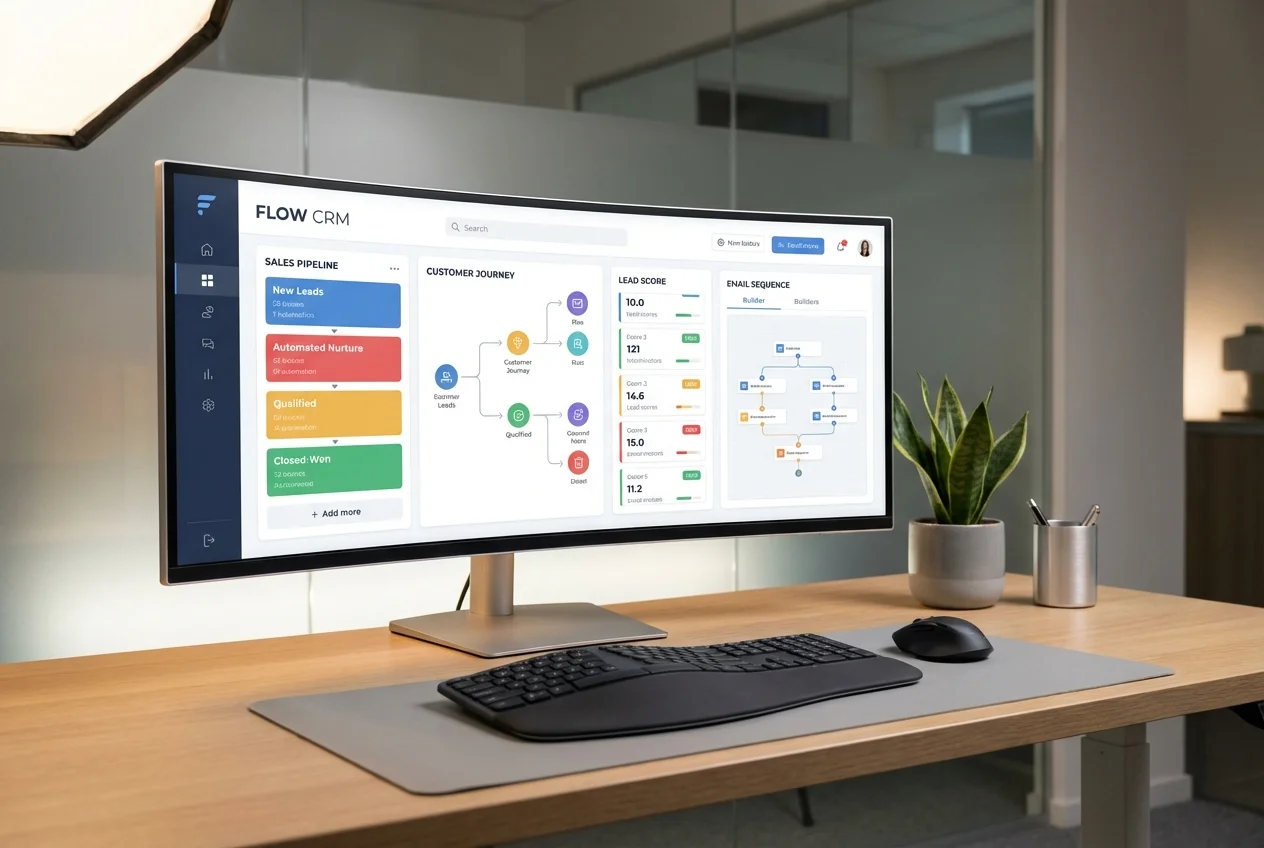
Inbound leads arrive from multiple sources in varying formats. An AI workflow agent can receive a new lead, research the company and contact using web search and CRM data, score the lead against defined criteria, draft a personalised outreach email, assign it to the right team member, and log all activity in the CRM — without any human involvement for standard leads. Exceptions (leads that match unusual profiles or require non-standard handling) are flagged for human review.
Contract and Document Processing
Processing supplier contracts, client agreements, or compliance documents is time-consuming and error-prone when done manually. An AI workflow agent can ingest a document, extract key terms and obligations, compare them against standard templates, flag deviations, and route for approval — completing in minutes what previously took hours. For enterprises processing hundreds of contracts per month, the time savings are substantial.
Customer Support Triage and Resolution
Tier-1 customer support involves a high volume of repetitive queries that can be resolved with access to account data and product documentation. An AI workflow agent can read incoming support requests, query relevant systems for account context, generate a response, and either send it automatically (for straightforward queries) or present it to a support agent for review and sending. This reduces average handling time significantly while improving consistency.
Financial Reconciliation and Reporting
Month-end reconciliation typically involves extracting data from multiple systems, comparing records, identifying discrepancies, and generating reports. An AI workflow agent can perform all of this autonomously, presenting a reconciliation report with flagged discrepancies for human sign-off rather than making a human do the data gathering and comparison work themselves.
Procurement and Supplier Management
Monitoring supplier performance, processing purchase orders, matching invoices to purchase orders, and flagging exceptions involves substantial coordination across finance, operations, and procurement systems. AI workflow agents can manage the routine elements of this cycle, escalating only genuine exceptions to human buyers.
Designing an AI Workflow Architecture
The Agent Loop
Every AI workflow agent operates in a loop: it receives input (a trigger event), perceives the current state (by querying relevant systems and data), reasons about what action to take, executes the action (calling a tool or API), and then evaluates whether the goal has been achieved. This loop continues until the task is complete or the agent determines it cannot proceed without human input.
Designing this loop correctly requires thinking about:
- Triggers: What initiates the workflow? A new email, a form submission, a scheduled time, a database record change?
- Tools and integrations: What systems does the agent need access to? CRM, email, document storage, databases, web search?
- Decision thresholds: At what point should the agent escalate to a human? What decisions is it authorised to make autonomously?
- Output format: Does the agent create a document, send an email, update a database record, or trigger another workflow?
- Error handling: How does the agent behave when it encounters unexpected inputs or system failures?
The Orchestrator-Worker Pattern
For complex multi-step workflows, a single agent attempting to handle everything becomes difficult to build, test, and maintain. The orchestrator-worker pattern solves this by separating the high-level coordination (orchestrator) from the specific task execution (workers).
The orchestrator receives the initial task, breaks it into sub-tasks, assigns sub-tasks to specialised workers, collects results, and synthesises them into the final output. Each worker is a focused agent with a narrow capability — document extraction, CRM querying, email drafting — that does one thing well. This modularity makes the system much easier to test, debug, and improve incrementally.
Memory and Context Management
AI agents need to maintain context across multi-step workflows. Short-term context (what has happened so far in the current task) is managed in the agent's working memory. Long-term context (patterns, preferences, historical data) is stored in a vector database and retrieved semantically when relevant. Getting memory right is critical for agents that handle tasks spanning multiple interactions or requiring historical context to make good decisions.
Implementation Approach: Phased Deployment
Phase 1: Discovery and Process Mapping
Before building anything, map the current state of the process in detail. Document every step, every decision point, every exception case, and every system involved. This is not just a process mapping exercise — it is a requirements specification for the AI workflow agent. The more thoroughly you understand the current process, the more accurately you can design the agent to replicate and improve it.
Phase 2: Minimum Viable Agent
Build the simplest version of the agent that handles the most common case. Do not try to handle all exceptions in the first version. Deploy it in shadow mode (running alongside the existing human process, comparing outputs but not taking real action) and measure accuracy. Iterate until accuracy meets your threshold.
Phase 3: Supervised Deployment
Enable the agent to take real actions, but require human approval for every action initially. This lets you validate real-world performance before removing the human from the loop. Monitor closely for the first two to four weeks. Keep a detailed log of every case where the agent would have made an error without human intervention.
Phase 4: Autonomous Operation with Monitoring
Once error rates are consistently below your threshold and the team trusts the agent's judgement, transition to autonomous operation for standard cases. Maintain escalation paths for exceptions. Review the agent's decisions regularly, at least monthly, and retrain or reconfigure when you detect drift.
Measuring AI Workflow Automation ROI
For any AI automation agency London or UK-based client, the business case for AI workflows must be quantifiable. Key metrics to track include:
- Time saved per task: Compare the time the agent takes against the previous manual time. Factor in time spent on exceptions and review.
- Throughput increase: How many more tasks can be processed in the same period? This is particularly important for processes where volume is the constraint.
- Error rate: Compare the agent's error rate against the human baseline. Well-designed agents typically achieve lower error rates on routine cases.
- Cost per transaction: Compare the total cost of the automated process (infrastructure, model usage, maintenance) against the previous cost (staff time, overhead).
- Employee satisfaction: Measuring whether the automation has freed your team from repetitive work and allowed them to focus on higher-value activities.
For most UK enterprises implementing AI workflow automation on the right processes, payback periods of two to four months are realistic, with ongoing ROI significantly exceeding the initial investment.
AI Workflow vs Business Automation: What an AI Automation Agency in the UK Delivers
An AI workflow is a multi-step process in which an AI agent reads inputs, decides, and acts across your tools. Business automation is the wider discipline of removing manual work from operations — rule-based integrations, CRM automation and reporting as well as AI agents. A good AI automation agency in the UK treats the two as one programme: rules for the predictable steps, AI agents for the judgement-heavy ones. If you are comparing a business automation agency with an automations agency that only does one style, ask which processes they would put in each category and why. See our CRM automation service for the rule-based side and our free consultation to scope your first AI workflow.
Choosing the Right AI Workflow Agency
Building AI workflow agents requires a different skill set from traditional software development. You need expertise in prompt engineering, LLM evaluation, tool integration, and the specific failure modes of agentic systems. Not every AI automation agency London businesses can choose from has genuine depth in this area.
When evaluating an AI workflow agency, ask:
- Have they built production AI agents that have been running for more than six months? What were the failure modes and how were they addressed?
- How do they evaluate agent accuracy before deployment? What is their testing methodology?
- How do they handle model updates from LLM providers that might change agent behaviour?
- What does their monitoring and incident response process look like for live agents?
- Can they show you examples of ROI measurement from previous engagements?
At Automation AI Agency, we have been building production AI workflow systems for UK enterprises since the technology matured enough for reliable deployment. Our approach prioritises transparency, measurable outcomes, and sustainable operation over impressive demos.
If you are considering AI workflow automation for your business and want an honest assessment of where it can deliver the strongest returns, book a free AI readiness assessment. We will review your highest-volume processes, identify the strongest automation candidates, and give you a realistic implementation plan with projected ROI — with no obligation.
 AI Workflow Automation
 CRM Automation
 Email & Marketing Automation